Showing posts with label beliefs. Show all posts

Saturday, September 15, 2012

The Season Changes


This week Jeph Jacques, he of the wonderful Questionable Content, found that he couldn’t draw his usual Thursday cartoon because of a deep and debilitating depression. He notes that this often happens to him at the changing of the seasons. I find myself wondering at this. I find season change deeply delightful.

The change from autumn to winter brings the anticipation of lighting the woodburner, drinking the raspberry vodka, the return of the stars (even in Sheffield), lights, decorations and christmas. From the end of December there’s the wonderful moment when the days start getting longer again and there’s the new chances provided by the new year.

By the beginning of spring I’ve usually had quite enough of those things, except the days drawing out. The first brave snowdrops, the expectation of warmer days, the promise of seedlings growing in the window, the return of colour to a grey world fill me with hope.

The transition from late spring to summer is probably my least favourite. I love late spring; fresh mornings, the darling buds of May, English asparagus, nettle soup, long warm days. 
Summer comes anyway. The garden (such as it is) is growing and I can move into sleeveless t-shirts and lose the quilt. And the lovely soft grey rains of summer are simply delicious. Not this year of course. Long term dreary deluge gets wearing after a while. And the swifts! Shrieking and diving through the deep canyons of our terrace-lined streets, amazingly distant crescents skimming the high sky.

The change of summer to autumn, though, is glorious, even as the swifts desert us for warmer climes. There’s a refreshing chill in the air. There’s a return to school feeling, the other new year, and I love it. English grown winter squash start to appear. The leaves begin to turn; a bounty of gaudy beauty. For me it feels that autumn begins after Sally’s birthday on 10th September. 

This year she was 21 and I begin to have to admit that my own transition from summer to autumn has pretty much gone. Over the last few years I’ve lost suppleness, strength and the elasticity in my skin seems to be fading. The things I’ve gained don’t seem to be that positive, mainly weight. I am loving my increasing invisibility however. Never having been backwards at coming forwards I can overcome young men’s inability to notice me if necessary, but there is something deeply peaceful about merging into the background. The hurly burly of the chaise lounge has been gone for some years now and I do occasionally look back with a certain wistfulness at the excitement, but only occasionally. I’m finding work increasingly rewarding, friendships of greater importance and I wake up far too early looking forward to each new day. Of course, getting out of bed takes longer and it takes a good few minutes for my feet and knees to loosen up. But then the lure of the early morning mug of tea encourages me to stumble down two Sheffield-steep flights of stairs to the kitchen. I’m currently mainly avoiding intimations of mortality and enjoying the days.

This week, leaning out of the Velux way before dawn I saw Orion above the horizon, faithfully accompanied by his hound, or at least I could see Sirius shining above the brightening horizon. Taurus and the Pleiades hung above him. There is not a glory of stars in Sheffield, and I miss that, but it makes the old favourite constellations easy to see. I guess the winter sky is so lovely to me because as an amateur astronomer of eleven it was the only one I got to know well. I was packed off to bed before the summer stars could be seen. It has the comfortable familiarity of many things known and loved in childhood. It’s been a gorgeously bright and blustery week. On my way to work this week I saw the local hot air balloon rising above the Botanical Gardens and some young guy, possibly not entirely sober, greeted me with the words, ‘Hiya darling. Have a blessed Wednesday!’ Of such things are happiness made. 

On a much, much darker note, this week the Hillsborough report was finally released. So many lives cut off horribly in the flower of their youth. So many lost so early, so many parents, lovers, friends with their lives blighted. I’ve always thought the lines, ‘They shall not grow old, as we that are left grow old: Age shall not weary them, nor the years condemn.’  was poppycock; a brave attempt at comfort. The end result of growing old may be weariness but it is a privilege to have the opportunity. It would be churlish to whine.  

Monday, May 16, 2011

I say farewell to my hopes and dreams

I cried today. I never thought I’d see this; a turning away from our outward urge. From Apollo 8 to this final flight of the Endeavour, I have followed our space exploration for years. In real terms Endeavour has not been the end. The end probably happened years ago when we decided that space exploration should give way to delivery runs to our global communications system. And exploration into space may well continue; reaching out to the future will pass to the developing world, to China and India. It has probably been a mistake to identify our access to space with NASA and the American push.

I sort of assumed I would spend my twenties and thirties in Luna City, moving out to the asteroid belt as my children, Jack and Selene, became independent and moved towards their own entrance into space. Seconds would have become true metric units as I thought in kiloseconds, megaseconds, gigaseconds, divorced from the constraints of planetary life.

Sigh.

When did my dream disappear? Did Star Wars do it?  Maybe. We seemed to become so embedded in our make believe that the reality of the careful, hugely expensive, preparations for each tiny step seemed silly and petty. In my mind’s eye I have journeyed out, swung around the astonishing rings of Saturn, plunged into the cold depths of interstellar space, walked on strange new worlds, gloried in communication with mysterious and beautiful aliens. Except we didn’t and haven’t and now we’re not even moving towards that vision. Why plod through the endless expensive tedium when cgi lets us believe we are the gods themselves?

Perhaps it’s for the best. Potentially we could squander all the wealth of our beautiful world on finally getting out to a cold and sterile place where we lament our loss; a world destroyed by our efforts to escape from it, a paradise where, if we had stayed, we might have flourished in serene joy. What we seem to have achieved is both less and more tragic than that. We have neither seeded the planets and stars nor relaxed into an eco-paradise. We’ve wasted our opportunities and our wealth on producing vast quantities of ugly trash in which we are slowly sinking. Damn! We are a pedestrian race who neither reach for the stars nor build something fine here on Earth. No wonder I weep.

Wednesday, May 11, 2011

Some more thoughts on banks


I mentioned my bank issues in Journey Planet really as a prelude to an appalling pun, however, it’s something that I want to return to after the Global Poverty project I’ve participated in recently.

To put it in context, although I grumble a lot I don’t usually move away from any provider. A mixture of inertia and loyalty. I have used two clearing banks in my life. My father worked for Midland Bank and so I banked with them until I got married, even when they heartlessly made him redundant. I only moved to my current bank because David, my husband, pointed out that if we ever needed to borrow money we would be better asking a bank with which we had a good credit record. I’d had a permanent overdraft with Midland. Until we married David had never been in debt with his bank. So, I closed my Midland account and we had a joint account with Barclays Bank.

I would never have chosen Barclays. The apartheid protests lingered in my awareness but David made a good point and at the time Barclays had divested themselves of the offending interests. So, we had a joint account and I settled into an apathetic relationship with Barclays.

Twenty three years later I am thinking again. I have always found the telephone ‘support’ from Barclays irritating. Some years ago I considered dumping the bank because of their Hard Sell but the branch staff in Kidderminster were really lovely and provided me with a direct dial so I didn’t have to go through the call centre. They told me at the time that they shouldn’t do this but many of their customers had the same problem and so, in order to keep some semblance of personal banking, they were ignoring the dictat.

My dissatisfaction has grown recently. About a year ago someone from Barclays phoned me up at work, ostensibly to check my payments, but actually to try to sell me cheaper house insurance. It wasted half an hour of my time that I then had to make up at the end of the day. Silly things started to irritate me. I now no longer visit a branch; all transactions are online, so there is never a personable teller to interact with, just an impersonal screen. In some ways I like this, but it means I have no loyalty, and the stupid tricks they play really annoy me. The ‘next’ button on each page is always below the visible window. The obvious button, which I occasionally click on inadvertently, is usually to a sales pitch – update your account to one that gives you useless ‘benefits’ and costs more, for example.

So, over recent years, some irritation. I suspect that this would be the case whichever bank I was with. As is regularly pointed out, they are businesses and they need to expand their business all the time (which is a rant for another time) but I am resistant to being sold to when I have no need and I resent having my time wasted, either online or by telephone sales calls.

What finally tipped the balance, some time on from the banking crisis, was Bob Diamond’s bonus, the pitiful amount of corporation tax paid and the news that Barclays is implicated in the further commoditisation of food via agricultural speculation using collateralised commodity obligations. For those living in extreme poverty, increasing food prices driven by financial speculation means starvation. Generally the people benefitting from food speculation have never been hungry in their lives, have never felt concern about their children suffering from malnutrition, have probably never thought of the consequences of one more financial bet. Barclays Capital are just the provider of this ‘service’ but the banks lobbied very hard for deregulation of the commodities markets to make this type of transaction possible and Barclays is the UK’s biggest player in the food commodities market, one of the big three in the world. I don’t want any part in supporting an organisation that is doing this. I am not under any illusion that taking my monthly pay packet away from them is going to make the least bit of difference to Barclays but I am moving my money to a mutual building society where I’m fairly sure my money will be supporting more benign projects.

Saturday, March 12, 2011

Protest!

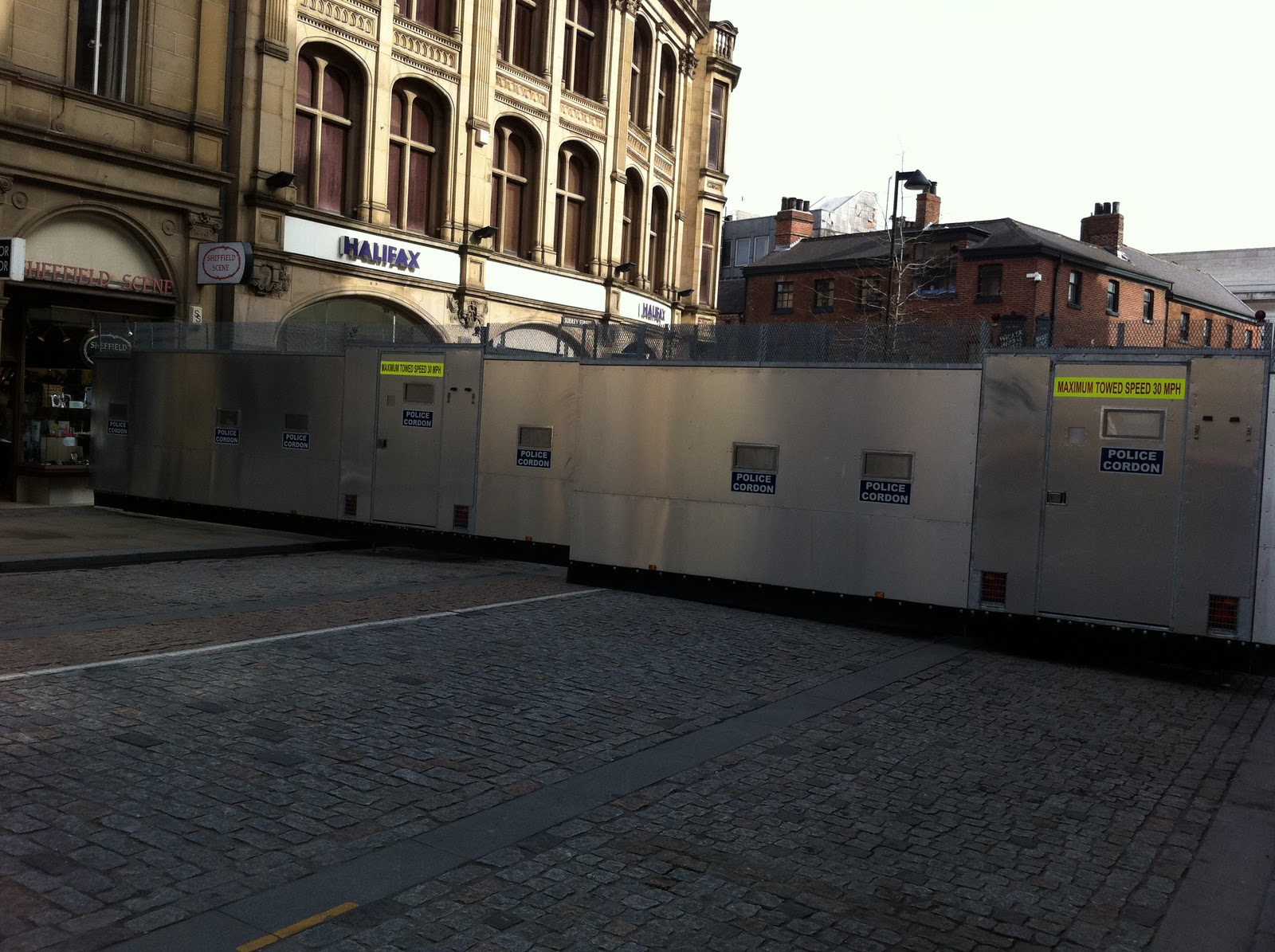
I went in to town today in between checking out an allotment site (more on that later) and going to lunch at FFW. I wanted to sort out a Nationwide ISA and in order to transfer funds I had to go to the branch in the town centre. Next to the City Hall. This is probably meaning nothing to anyone outside Sheffield right now but anyone living in Sheffield knows that the LibDem conference is being held at the City Hall in Sheffield over the weekend and we have a bitter taste of what it might feel like to live in a police state.

There was something of a protest going on based on the fact that a lot of us voted LibDem at the last election as they professed to be the most 'liberal' party in the country, only to find our party supporting a lot of policies that we would never countenance, not least the privitisation of the NHS.

As it happens the police were relatively pleasant, probably joyful to receive excessive overtime and danger payments in a time of pay cuts.

I made my way through the barricades to my building society and signed the relevant paperwork. Other than the staff and me there was no-one in the branch. Excellent! Some of the staff were terrified. As one women said, 'It only takes one idiot to kick off and they'll be breaking our windows and who knows what else'.

Curious and, it must be admitted, feeling a certain level of dissatisfaction myself, I went for a wander into the heart of the protest. It was an astoundingly good natured event. Despite the banners and shouts I never for a moment felt in danger from anyone on the protest side of the divide although the barking of the police dogs from inside the barriers around the City Hall was very scary. The local Samba band made the event feel like a festival and the number of people with young kids dispelled any notion that this was a dangerous protest. As I walked away I felt a little sorry for the police, unable to partake of this moment of togetherness. Sheffield is a wonderful place to be and on a cool spring day to feel at one with people protesting the dismantling of our social system was good.

It was very strange to see large forces of police, out on the edge, 'protecting' the people from the people. It reminded me of the sad divisions and fear generated by the miner's strike. I hope we can keep our senses together and remember that protest is one of the things that stops us making stupid mistakes and that disagreeing with government policies and decisions does not make us either bad or dangerous people.

Strangely, outside Sheffield I don't think anyone is very aware of these protests. My choice would be to make my feelings known at the next election but I may be wrong and that might be too late. I'm very glad that there are people still passionate enough to protest in this sad and scared little island.

Thursday, February 24, 2011

Resilience

I’m doing a college course at the moment and one of the requirements is that I put together and deliver a five-minute presentation on a subject of my choice. It mustn’t be work related. Five minutes is a scarily short amount of time. When I’m training we usually haven’t even got to where the loos are by five minutes. I tend to be garrulous. Crikey!
So, if not work related, what? There’d be too much setting up required to talk about science fiction, my abiding passion. I’m not sure a knitting demonstration is what the tutor had in mind, and I’m not allowed to talk about climate change. Then I had an epiphany. I’m going to talk about resilience. It is related to work but, although I touch on it in relationship to environmental issues in some courses, it isn’t something that is central to my job and it is something that I’m concerned about in my personal life. Here’s the first draft:

I’m going to talk today about resilience. Resilience is the ability to bounce back from a shock. I think the opposite would be brittleness or fragility. It is a concept that can be applied to all sorts of things, from a material to a civilisation. Hands up those who think our current civilisation is resilient.

You might guess that I don’t. The fragility of our modern British civilisation first impacted on me in the early 70s. I remember it vividly. The family was watching Star Trek and some horrid black blob beast had battened onto Spock’s back when, Bang! The lights went out. This, our first power cut of the miners’ strike, dropped us from the far galaxy spanning future directly into the cold dark scary past.

At the time we lived on a modern housing estate. When it was built a large underground oil storage tank had been provided to serve the heating needs of the whole estate. Oil was pumped through to the central heating boiler of each house. No electricity, no light, no heat. In my grandparents’ home there would have been warmth and some light from the open fire. There’d have been hot water from the geezer and the gas cooker would work for a while until the gas pressure fell. And, coming from the generation that lived through the war, they had a healthy stash of candles.

Our modern and efficient house contained exactly one candle, the advent candle. By the time the lights came back on there was only a dribbly red stub left… And there was a run on candles the next day in the village. None available, not even for ready money.

I think the experience had a salutary effect on me. That and the extensive reading of disaster SF. It’s not at the forefront of my thoughts all the time but the awareness of fragility squats at the back of my mind. I’m convinced we haven’t learnt from our experiences. Our systems are terrifically efficient and terribly brittle.

What could possibly go wrong? Drought in Russia, floods in Australia, land used to grow biofuels, a growing appetite for grain fed meat in the new middle classes in China and India, speculation in commodities; all leading to escalating food prices. Not immediate enough? We’re all rich enough not to go hungry after all.

We import over 40% of our gas now. Another very cold winter, low gas storage levels, a disruption similar to the one that affected central Europe whilst Russia and the Ukraine squabbled about who was or was not stealing gas. How would we fare? A lot of our electricity is gas powered now too.

Or imagine the same very cold winter, more likely as the climate changes, causing water pipes to freeze and burst. It happened in Northern Ireland this last winter. Weeks with only bottled water.

How about another volcano? A problem with oils supplies? Remember the oil refinery blockade a few years ago? No petrol at the pumps? Very quickly little food in the shops?

Just in Time deliveries are extremely efficient but they are not resilient. We have spent the last several years working to become super-efficient, to trim down to the bare bones. A system without fat is fine if there is no famine. Resilience is all about redundancy though. When the main system fails a secondary system takes the load. If that fails there is another backup. That’s not efficient. Efficiency is fine as long as everything goes to plan and nothing breaks down.

OK. Given my awareness of the dangers have I organised my life so I am safe from these failures? I have candles, I have a newly installed woodburning stove, I have a decent amount of food storage. I feel happy that I could weather a week’s disruption without pain but more than that? Water would be a problem in my urban environment, and a build up of waste. In reality my life can only be resilient in the context of a resilient society and not only do we not have one of those, our society is getting more and more brittle all the time. 

Thursday, November 18, 2010

Proper Use of Knowledge

I had a very interesting weekend. I've been in Nottingham for the wonderfully fannish SF convention, Novacon. I've loved this convention since the very second time I attended. This year Sally came with us. I wasn't sure how much fun it would be for her given that, other than the next generation of fans in the approaching pubescent age and younger, the youngest person is probably in their thirties and the average age looks to be late fifties. As far as I can tell, though, there was enough amusement and book purchasing opportunities to make it a weekend well spent for her.


There were two stand out moments for me. Not Ken MacLeod interviewing Iain Banks though that was an amusing glimpse into a firm friendship and Iain's way of thinking. Not Julian's occasionally immoderate moderating of Iain Banks, Geoff Ryman and Charlie Stross's discussions about hard and mundane SF, fascinating though that was. Not even James Bacon with his endearing rendition of one of Bob Shaw's serious scientific talks although that was very wonderful. No, my moments were less comfortable though more enlightening than any of those.


The first moment came as I arrived at Tarn Thai on Friday evening, decanted from the taxi I had shared with Julia, Doug and Julian. Ian and Sally were waiting outside the restaurant although the rest of the party had gone in. 'There's a problem,' understated Ian. 


I looked at Sally who was hardly breathing in an effort not to cry. 'What's wrong?' I asked and the tight control dissolved into wild sobs. Horribly, I couldn't understand a word she said. Eventually I fathomed it. Her much loved science teacher from school, Mr Friedeberg, had died suddenly. He had been one of those teachers who hadn't lapsed into cynicism or despair but had continued to give huge amounts of time and effort to his pupils. Sally had benefitted from a great deal of extra help from him and her grade B in chemistry was a result of his enthusiasm and selfless dedication as well as her hard work and willpower. He made his subjects interesting and comprehensible, passing his enthusiasm on to the kids who responded by working hard to achieve, and by loving him. Apparently his funeral was so packed that there was no space left.


Once the first powerful torrent of grief had abated somewhat I called a taxi and the two of us went back to the hotel and sat in my room. She talked about the man and what had happened. Mr Friedeberg hasn't been the first important person in Sally's life to die. Both my father and Paul, her Dad's mother, have died but both deaths followed a long period of worsening health and increasing pain, both as a result of brain tumors. The deaths were slow and awful and ultimately a relief. There was plenty of time to say goodbye. Mr Friedeberg died unexpectedly. One of the things that bothered her when she was finally able to drink a mug of tea and reflect on the shock was that she had missed the funeral. When I spoke to her father the next day he said he had known about the death and the funeral but didn't think Sally would be interested and was reluctant to mention it. Augh!!!


OK, so that was my first stand out moment. The next evening we went out to Pappa's for a really substantial Greek meal; enough vegetarian meze for six served to Sally, June and me whilst the remaining five ate enough meat for many more people. We staggered back and Ian, Sally and I subsided on the sofas in the dimly lit back of the bar. We girls had made a bit of an effort with makeup so Ian snapped us with his new iPhone. They're interesting pictures, despite Sally's strange otherworldly silver eyes. Later in the evening Ian showed the pictures to Liam Proven who seemed more concerned than a technical problem might indicate. He suggested to Sally that she should get her eyes looked at, probably not a problem, but really. Do it! When Sally backed away he came and spoke to me. Initially he didn't want to explain but I pressed him. Apparently there had recently been a story about a toddler who, in her birthday photographs had one redeye reflection and one eye that reflected white. The white reflection was a result of cancer of the retina which displaced the capillaries that cause redeye. Very gently, after repeating that it was extremely unlikely, he told me that that type of cancer had a very good chance of cure if caught early enough, but the eyes would have to be removed. I looked across at Sally who was chatting to Julia. She was animated, happy and very beautiful. I can't begin to describe the dread and grief I felt. Liam repeated that it was very unlikely, that it usually happens to much younger children but that, really, to be on the safe side, I should make sure she got it checked. He wandered off leaving me ashen.


Five minutes later I'd explained Liam's warning to Ian and he'd immediately devised a scientific experiment. He dashed upstairs for his usual camera. Photographs of Sally with this displayed wonderful, lovely redeye. Photos of Julia with the iPhone had scary silver eyes. Somehow it must be function of how the flash works on an iPhone. My relief was almost as devastating as the fear. I didn't know what to do with myself. 


I would like to note here that Ian's reaction is one of the reasons why I love him so much. In a crisis he is calm, clear thinking and wonderfully practical. Laura Wheatly and Julia Daly, also practical and terrifically sensible, helped me calm down from my adrenaline high. 


So. It was a false alarm. I was utterly terrified for, as it turns out, no reason. Should Liam have kept quiet because the information would upset me? Good God no! I never want to have another trauma like that but half an hour of deep terror is trifling compared to losing my child. 
My final point is that information can often cause pain but without it we may make false choices with results that might range from mildly embarrassing to disastrous. Failing to pass information either shows a lack of respect for a person or cowardice. I never think it is better not to know. We can't be in control of our own destinies if we have no conception of reality. We can only gauge that by obtaining all the information and testing it. And then maybe seeking the support of understanding friends.


Sunday, November 7, 2010

Finding a balance


Over a year ago now I took a two-week permaculture design course. It was fascinating, traumatising (who knew I had so many issues around the word ‘home’?) and, I thought at the time, life changing. And then I came home and fell immediately into default mode. Sigh…


I have a few issues with permaculture, and with Transition that grew out of it. It’s nothing to do with the ideas, which I think are useful and fundamentally sound. It is the monetising of it and the branding. Some of this may also be because I am not a belonger. In my life I have been involved in a lot of organisations, in some cases giving a lot of my time and energy to them, but I’ve never felt any real sense of belonging and the associated obligation that comes with belonging. The closest I come to it, outside of my family, is to fandom but, for me, fandom is Not a way of life. I regard it with wonder sometimes, amazed at the generosity of its component parts, the occasional infighting, the passion and the energy (in some cases) but perhaps because it feels like a huge extended family, I can take or leave the obligations. Recently I have thought that maybe I’ve wandered too far away from fandom because of the huge amount of time and energy work is consuming. Time to reconsider.


So, yes. Where was I? Changing my life. I have continued to do stuff but it’s not to a plan, to a design, and as a consequence, it tends to drift into triviality and pointlessness. Given that I spend most of my time in systems management I am a big fan of the Plan-Do-Check-Act cycle but, despite my best intentions, I’ve never even got to the ‘plan’ stage. I’m not even sure that I’m having much of a positive effect at all due to my lack of organisation (how can I save the world if I can’t define what that would mean (or find my keys))? I’ve got a list of objectives. I’ve had them for two years. I’ve made no progress.


So, with a small amount of enthusiasm, I am looking at being part of Sharon Astyk’s Whole Life Redesign Project! Sharon identified seven areas she aspired to change. There are clear matches with my long ignored objectives.


Sharon’s suggestion - Domestic Economy
‘This is the territory of home life. Here's where we start thinking about what we want our home life to actually be like. For me, the critical requirements are less cluttered, less disorganized, a home that functions better in relationship to what I actually do and intend to do at home. I'd like to set up the house in order to be able to bring people here for some of my teaching projects, and also to use some of the space for farm projects.’


My version of this was ‘Comfortable Home’. Well, if I’m going to be totally honest it was ‘Home for Gracious Living’ but anyone who has been to my mildly squalid terrace house in Sheffield will know that it is unlikely that I could actually aspire to gracious living there. I’m a lazy housekeeper and I’ve not got huge quantities of cash available to transform it. I could, however, work towards the less lofty objective of a comfortable home.
As Sharon notes, clutter and disorganization make for both a less comfortable and a less thrifty home. I occasionally buy things knowing that, somewhere in the house, there is a perfectly adequate resource of the type I’m looking for, I just can’t put my hand on it. I’ve been in my house since June 2007. I still haven’t unpacked my last boxes. Part of the problem is that I accumulated a lot of stuff in the large marital home. I’ve moved to a much more modest house but not divested myself of all the trash I’d accumulated.
I mentioned this to Claire Brialey some time ago and said I was going to get rid of some books. She looked at me aghast. Once started on that road where would one stop? The Bible and the complete works of Shakespeare? And yet I have many books that I will never read again and would not recommend to anyone else. Why keep them? Ah yes, but the last time I got rid of a dreadful book, The Tides of Lust by Samuel R Delany I found a couple of months later that I wanted to quote from it in order to demonstrate how awful it was – beautifully written but really rather nasty. Similarly, Vivia by Tanith Lee. Tides was replaced – a friend sent me a copy. Vivia never left. I think perhaps what I should do is get rid of the mediocre books and keep the well-written trash. And yet, and yet…
I am truly a packrat in the traditional fannish way but I could really do with simplifying. I’m thinking of starting to actually use the library again rather than keep so many books. It also helps keep books in libraries relevant.
I made a start last weekend when Ian was in Washington. I assembled some more bookcases and got most of my books finally out of boxes. Once they’re all out I’ll start winnowing. James Bacon and John Dowd have a fostering service set up to place unloved books. I may well make use of it. This is a very big project but one that I would like to start on.


Sharon’s suggestion - Household Economy
This is the territory of making ends meet and meeting financial goals. My goals here are to up the portion of our personal economy that comes from barter and personal exchanges, to drop our expenses by 20% and transfer the money to savings and to infrastructure like insulation that will cut expenses in the longer term. I want to have a plan for dealing with money and benefits cuts that we expect on Eric's end.’


Strangely I didn’t have anything like this in my objectives despite the fact that this is one of the areas I have been working on quite hard in the last couple of years. It makes sense to add it in and I’ve called it ‘Economic Viability’.
Attaining economic viability has been a long hard struggle. I took ten years out with my children and when I finally went back to work it was for the same salary I had started on as a graduate many years before. It took a lot of hard work, hard nosed pushing and a master’s degree to get me back into the salary level that I could survive as a single parent again. When David and I separated and I moved to Sheffield I was quite comfortably off as long as I cut out all the luxuries I’d used to enjoy. I cut. Things were fine.
Then the Crash and the struggle. In order to keep the company viable we all took a 20% pay cut. I cut out half of my charity donations, I stopped using contact lenses, I stopped impulse buying, I stopped buying lunches, and I started using Zen Budgeting. This turned out to work very well, to the extent that I found I could live quite comfortably within these limits. Given that I have enough money but hardly any time I have decided, now I’m back to full pay, to work a four-day week. Should everything go horribly wrong again I would be hard pushed to live on a 40% cut though. That’d mean getting rid of the TV, Demon, the rest of my charities etc. This is definitely an area that I need to monitor.
(I should also mention, in this section, that we benefit from the Ian subsidy – for which I am very grateful, and which means I drink much nicer wine more often than I would otherwise.)


Sharon’s suggestion - Resource Consumption
This is the territory of what we use. Our lives are enhanced when we use less, and so are the lives of others and our environment - it is as simple as that. We've seen some creep in our energy usage, and we need to get it back down. Right now our family of six is using less than 1/5 the US average (and most of those are based on household numbers with the average US household being 2.6), but I want to get back closer to 1/10th which, while not a fair share, is a lot closer. We need to get back in the habit of accurate bookkeeping on our energy usage as well.’


My version of this was called ‘Living Lightly’ and I’ve been very poor at achieving anything. Last year I started on the Riot for Austerity but didn’t get very far with it. I found trying to convert everything a pain and I never took the time to set up a proper spreadsheet. This year I joined Sheffield’s CRAG, the Carbon Action Rationing Group. I have found this simply fascinating. As my friends would attest, I keep my house on the chilly side, use public transport all the time (except when I go somewhere in Ian’s car) and don’t fly and yet my carbon production to date this year is 1293kg. The UK per capita average is 4500kg so you’d think I was doing quite well but this was set up by financial year and there has only been temperate months so far. Also it doesn’t include carbon impacts generated by my business travel. Admittedly my house is old and draughty but there must be lots of people out there who never have the heating on and go nowhere in order to generate an average of 4500kg. Another one to make more effort over. I’m replacing my old leaky front door and hope that will help. I’ve got plans to insulate the floor. We’ll see.


Sharon’s suggestion - Farm and Subsistence
‘This category may be more relevant to us than some people, but everyone does some subsistence work. For us, we want the farm to be the center of our lives, and to integrate ourselves more into the farm - that is, we want as much as possible my work and our lives and the farm to be one thing. For a long time we've used Eric's work to subsidize the farm, but now it needs to be self-supporting, and that's part of that equation, while we also expose what we're doing in low input agriculture to other people. We'd also like to up the degree to which our subsistence activities teach and help others. Most of all, I want to do a full evaluation of all our projects, both so that others can begin to understand them, and also to make sure that we are doing everything we do as well as possible.’


This doesn’t have a real equivalent for me. I have no farm and no real interest in having one. I could make this ‘Productive Garden’ and try to do a better job of dealing with the slugs. This has been my intention anyway, and may be a good use of my extra day a week.


Sharon’s suggestion - Family and Community
‘This is a big one for us - the reason we considered moving earlier this year was the desire for a closer knit community - we had that but have seen some changes over the years. But the reality is that we've been allowing those changes to frustrate us, but haven't necessarily worked as hard as we could to compensate. So our goal is to spend more time working on our community building, and bringing our far-flung communities and our local ones into a state of connection. It is sometimes hard to be so far from our family, from close friends, but if we can build better on what's near us, we can reach out through a chain of links, rather than across a wide distance.’


This is a worry for me and I had it down, rather ridiculously, as ‘Maintaining Joyful Relationships’. I’m rubbish at this. Over the years I have lost contact with many lovely friends because I don’t find time to keep in touch. The exception to this is Sally, who I live with, my lovely colleagues at work and Ian. Luckily I have some great friends who I can pick up with easily. Again, I’m hoping that my extra day will give me some time to catch up with friends.
On the same subject, many of the important people in my life refuse to live next door to me or even in the same town. I am very disappointed in them! Jack is in Oxford, my family is in Leeds and Ian is in Motherwell, at least a four-hour train journey away. I worry about how the slow erosion of wealth and energy I expect will impact on these long distance relationships. I have no answer to this predicament but think that this is also an objective that I should concentrate on.


Sharon’s suggestion - Outside Work
‘If my children were hungry, I would and could do any work necessary - there is no doubt about that. But while my family lives on comparatively little money (we qualify for food stamps in our state, although we don't use them), we also have enjoyed the fact that we have the luxury of choosing our work. In many ways, we've had an enormous luxury - my writing and teaching and farming didn't have to pay much, because Eric was subsidizing them. Now my work may have to support us, but I still want, to the extent that's possible, to make what I do the right thing to do. I am enormously fortunate, in that I can earn money doing what I care about, and that I have had the luxury of giving things - my writing, my farm products, etc... away for free. Indeed, often the return of giving things away has been greater than those I use for money - but I don't live entirely outside the cash economy, unfortunately. So I need to balance my work - find the ways to make some money doing what I care about, while reducing expenses, so that I have the luxury of keeping giving things away.’


This one I called ‘Meaningful Work’. I’m very happy that I have work that is environmentally based and makes something of a difference. I say ‘something’ because I am working with the business community and some things are not up for discussion. I spend a lot of time talking about sustainability but what the government and business mean by sustainability is predicated on an economics based on growth, a concept that is not in any way consistent with sustainability. Still, it’s more meaningful than stacking supermarket shelves and better paid. My objective is, I suppose, to support businesses in moving towards sustainability, even if it is a watered down version.


Sharon’s suggestion - Time and Happiness


In the end, these balance sheets have to be even for me to begin to go forward. The good thing about this is that I know how easy it is to even up this part of the equation. My husband and children and the farm and gardens, friends and family give me a deep, inner core of happiness. Whether we stay or go, whatever changes we make, whatever we do without or give up, if I have some simple things - a little dirt (and I don't have to own it) and the loves of my lives in place, I am not afraid of the future, and I am happy. The thing that buys me the most happiness is time - but it doesn't have to be free time. Indeed, the thing that gives me the most comfort in the world is knowing that Eric and I can spend an entire day working in arm's reach of one another, with the boys helping and playing around our work, and know that at the end of the day, all of us, exhausted, will have found the time well spent. Finding time and finding happiness, are not, for us, a matter of more vacation time or things we want to try - they are simply the by products of trying to bring the pieces of our lives together.’


This is a part of what I have included under ‘Healthy Lifestyle’. I find getting a balance in time use very difficult. I’m not a fast worker and I have a personal requirement to produce work that satisfies my own standards, especially when I am training. It’s self-defense really. I don’t want to be embarrassed by not doing a good job. The problem is that this eats into my own time. That and the fact that wherever possible I travel by public transport for work. It gives me more productive time (I can work rather than just drive) but it takes longer and extends my working day. I’m tired all the time. My feet hurt, I’m overweight, I’m unfit and I haven’t the time to do anything more than try to catch up on my sleep and cook proper meals from scratch. Even that I’m not doing very well. Julia Daly has cooked a couple of splendid meals for us recently, the leftovers from which have been the basis of our meals for the rest of the week.


So, a whole host of things to think about, objectives in place and targets to set. I’ll let you know how it goes.

Monday, August 23, 2010

Reporting the environment

Ian recently sent me a link to an article on The Register. He often sends me links just to annoy me. I usually read them, feel a bit grumpy, then forget them. This one, though, just about hit my tolerance limit. It's a fabulous example of bad reporting, drawing conclusions that are unwarranted from the information.


The piece is titled, 'People have NO BLOODY IDEA about saving energy' and subtitled, 'Those keenest to be green are most ignorant - survey.' I guess they provide fair warning in their titling that this is not an objective report. It is, however, based on a fairly interesting piece of scientific research and the Register were good enough to provide  a link to the original paper


Having read both the Register's article and the original paper, 'Public perceptions of energy consumption and savings', I can agree what the Register reported was not incorrect but the spin they had imparted to a sober little paper was so strenuous it is probably still reeling. 


What the original article says is that people are not fully aware of the energy used by their various activities, appliances or embodied in the products they use. From the information presented this is true. 


I will even admit, sheepishly, that the contrasting embodied energy costs for glass and aluminium surprised me. I hadn't really thought about it but it seems fairly obvious that this would be the case once I had given it some thought. The melting point of aluminium is around 660C, for glass it is at least 1400C, depending on constituents. From this the Register concludes that 'as a true eco-person, you shouldn't be recycling glass, you ought not to be using it at all.' Well, yes. And no. Unfortunately, at present I am unable to find the sort of wine I want to drink in aluminium cans. Given that I am unlikely to stop drinking wine in the immediate future it is still better for me to send my glass bottles for recycling than not*. 


The article continues, 'Again, when asked what the single most effective thing they could do to save energy, the most popular response in the survey was to turn off lights. In fact lighting accounts for a relatively small proportion of the average person's energy use and almost all of us could save far more juice (and carbon) in other ways - for instance by turning the heating down as little as a single degree, something which many extremely keen lightswitch nazis** refuse to do.'


I have an issue with this paragraph. I am not disputing that turning the heating down will save more energy than turning off lights, but there is also no reason not to turn lights off in a room not being used. The Register seems very keen on either/or choices. It might surprise them but it is quite possible to turn the heating down by one degree and turn lights off in unused rooms. 


They go on to quote the original paper that states 'participants estimated that line drying saves more energy than changing the washer's settings (the reverse is true)'. My concern with this statement is twofold. One is that I always wonder when I hear such loose phrasing. 'Changing the washer's settings' could mean anything from reducing the temperature by 10 degrees to reducing it from 90C to 30C or more. Looking at the paper's Figure 1 it is quite possible that, depending on what that phrase means, line drying may be a better saver. Difficult to tell; the graph is small with a logarithmic scale. My other concern again is, what does it matter? Both of these are potentially high energy saving. Change the washer settings and line dry. 


Never mind though, the Register goes on from this paragraph to state, 'Perhaps the killer revelation from the survey is that it is, in fact, the very people who are keenest and most active about reducing their energy consumption who are the most ignorant.' Despite the exaggeration and emotive language this is, in fact, the conclusion of the paper. People are optimistic that what they are doing is having a positive effect. Their perceptions are not as accurate as they could be. This is a problem if for example, you comfort yourself that the impact of your flight to Australia will be offset by turning the lights out and recycling your wine bottles. It may also be a problem if, as a Register reader, you can only take one action at a time so rather than turn your thermostat down, line dry your clothes, boil only as much water as you need and cycle to work you unplug your phone charger. 


The lesson the Register takes from the information contained within the paper is, 'In other words, ignore that earnest friend of yours who recycles religiously, turns off the lights all the time, and unplugs the telly every night... They quite literally have no idea what they are talking about.' Well no, that's not what the paper said. The original paper suggested that better and more accurate information would help to reduce emissions and public information campaigns should focus on behaviours that could have a greater effect - forget the phone chargers and turn down the heating.  They conclude, 'It is therefore vital that public communications about climate change also address misconceptions about energy consumption and savings, so that people can make better decisions for their pocketbooks and the planet.'  The Register, on the other hand, concludes that we should 'ignore the many worth organisations - for instance the Energy Saving Trust here in the UK, which you pay for through your taxes - which have made us all so ignorant.' I took a quick look at the EST website. The top ten tips did indeed include the admonition, 'Don't leave appliances on stand-by and remember not to leave laptops and mobile phones on charge unnecessarily'. It also, however, suggested sorting out dripping hot water taps, fully loading our washing machines, boiling only as much water as needed, changing to low energy bulbs, turning lights off, closing curtains at dusk and draught proofing, turning your water thermostat down (also reduces the risk of scalding small children) and turning your central heating thermostat down. The information on the site would be improved if each tactic was rated on energy saving effectiveness but the tips given were all generally good and do not seem to me to be making us ignorant. The worst that could be said is that it is not as informative as it could be.


I wonder what the Register gains by subverting a worthy piece of research. It makes no sense to me. Unless the author of the piece is still living with his parents who keep turning the lights out on him.


*Ideally glass bottles should be reused. My milkman very kindly takes my glass milk bottles back for reuse. It doesn't need vastly more energy to take them back because he was coming to my house to deliver anyway. 


**As a rule of thumb, use of the word nazi in an article not talking about the german fascist movement of the mid 20th century is an indicator of a lack of objectivity.   

Wednesday, August 11, 2010

Some thoughts inspired by Inception

This year we're taking it easy at the Fringe. We haven't booked a flat in Edinburgh and we've only got three days of shows booked. This is the most lightly programmed Fringe we've done together. 


Having woken up a little late on Sunday and lolled around in our dressing gowns for most of the morning we conceived a plan. We would wander over to Hamilton and eat a late lunch at Amigo's with salty margaritas then go to see Inception. Julian had already seen Toy Story 3, our first choice, and Sally had recommended Inception. Martin Easterbrook had too, but my vote was swayed by Sally. And the fact that it was skiffy.


So. Inception. I loved it. A nested thriller that communicated unease and terror amazingly well. How scary to have a technique that allows someone to enter your dreams to take information or, worse, to implant something that isn't so. 


Once in the dream, time passes more slowly so that the operators have time to achieve their mission. It is possible to enter a dream within a dream, which is complicated, much deeper and has another slowdown of time passing. Wonderfully, what is happening in the dream level above the one you are in affects you, so when in one level the sleeping bodies are falling, in the waking dream they are in free-fall. 


In the big operation central to the film a set of four nested dreams were planned. It had been established at the beginning that if you die in the dream you wake up back in the real world. Somewhere, though, in the early stages of the big operation it is revealed that the technology and choice of drugs means that this time there is no safe release from the dream. With the time extension afforded by the dream the protagonists could be lost in the underlying chaos state for decades. This change increases the tension many fold. 


I am fascinated by the nature of reality - one of the worst things you can do, in my faith system, is to hide truth from someone. This is a huge betrayal because it doesn't allow a person to make reasoned decisions based on reality. (Whilst I'm typing this Alec states, 'An engineer might steal your wallet, sleep with your wife but he will not lie to you on technical issues.) 


We all do hide truth, of course, mainly to protect our own fragile ego. Last week, for example, Sam came to look at my house because I have some work that needs doing. I thought about spending every evening of the week cleaning and tidying so that, as I told Ali, he wouldn't know what I was like. The two things that stopped me were not moral principles, of course, but laziness and futility; should he spend any time at my house the thin facade of tidiness would end up on the floor with all the other detritus and half-read books. 


Well, yes, Inception was a film that I was expecting to find morally bankrupt but, surprisingly, it was a supremely intelligent thriller that made the danger of this manipulation concrete and clung hard to the need to reattain reality. The most moving moment in the film was when the central character abandoned the dream of his wife and determined to return to his children and responsibilities. And that was the other strength of the film. The characters had some depth and I cared about how it turned out for them.


There were moments reminiscent of 'Better than Life'. There have certainly been times when I have why anyone would ever step outside that game. The Red Dwarf crew certainly had no responsibilities to ground them in reality. Perhaps I'll dig the DVDs out and re-watch them. 


Later, we spent the evening watching last week's and then this week's Sherlock Holmes. I'm sort of thinking that I might make it the other reason to turn  my TV. Other than Dr Who. The new Sherlock Holmes is a Moffat & Gatiss idea that brings the stories into the 21st century. Sherlock is both beautiful and monstrous and Watson is the only truly sympathetic character. Unlike most of fandom I've never read any of Conan Doyle's books and the films I've seen have never made me want to, but this update has tempted me to reconsider the books that are, again, all about discovering the truth.


It occurs to me that following the rules of the Inception world you could 'live' almost forever if you submerge yourself in deeply nested dreams. This would, however, require you to have a completely happy subconscious so you don't undermine your world, a bloody good imagination to people your world with and/or a fully compatible companion, and someone to keep your body maintained in the real world.